
The European External Borders
What do we mean by European (external) borders?
We talk about European (external) borders all the time — but what do we mean, and why do we always put “external” in brackets? You can find a brief explanation of our understanding of borders in the glossary.
It is important for us to stress that borders are not natural facts. Although the Mediterranean Sea may appear to be one, it would not be a deadly border if all people could simply cross it by ferry and plane. The fact that this is not the case is not because it is not possible, but because it is not politically desired.
The Mediterranean Sea is an example of a European external border. Other national borders within Europe are also relevant for people on the move. The fact that not only national borders play a role is shown by the two English terms border and boundary, for which there is only the word “Grenze” in German.
Borders
Borders are perceived as lines between two territories and are associated with an inside and an outside. They are closely related to the territorial state, which defines legal subjects and controls them at the borders.
Boundaries
Boundaries describe processes of distinction beyond geography. They create symbolic differences, for example between classes, genders, or races, and contribute to the formation of identities.
At Europe’s external borders, support work is necessary because of the politically maintained situation. At the same time, there are other European borders that EU citizens can easily cross, while people on the move cannot in the same way.
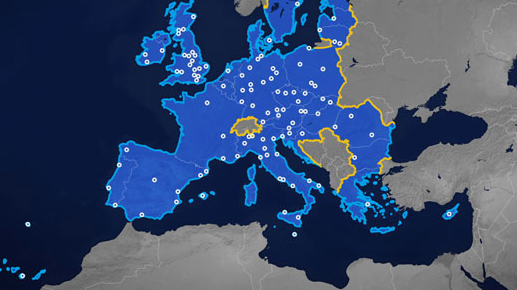 This picture shows a map of the external borders of EU/UK.
Sources
- Bigo, Didier (2005): Frontier Controls in the European Union: Who is in Control? In: Controlling Frontiers. London: Routledge.
- Fassin, Didier (2011): Policing Borders, Producing Boundaries. Annu. Rev. Anthropol. 40 (1): 213–226.
