Allyship and Solidarity: Conceptual Roots and Implications
What is wrong with “Allyship”?
▶Performative allyship: attention on allies’ work instead of the group meant to be supported
▶Tokenistic allyship: fast band-aid solutions that maintain the status quo
Some forms of allyship reproduce patterns of social inequality that blame minorities for their oppression and offer band-aid solutions rather than addressing the roots of structural and systematic oppression. Often, such allyship is concerned with maintaining — rather than disrupting — the status quo.
Looking at tokenistic solidarity in the Mirnajafi and Barlow (106) describe symbolic solidarity as manifesting itself in ways that anger and shock people confronted by violence, but never translates the same rage into concrete actions to change the course of violence. They further identify the problems with symbolic solidarity and in the context of people on the move as follows: “1) for people on the move, the distress is ongoing, and 2) situation of migration did not occur in a vacuum, and the societal factors that give rise to Western Islamophobia, White nationalism, and intergroup violence have not been eliminated” (107). Therefore, the solidarity that is needed to support must encompass ongoing action, regardless of how complicated, hard, or imperfect the work of solidarity might be. …tokenistic ally, the words offer comfort and safety, but even though it is hard the actions allow an environment of threat to flourish… . A practical look at how to move beyond tokenistic solidarity must acknowledge this, and deal with the problem head on (108).
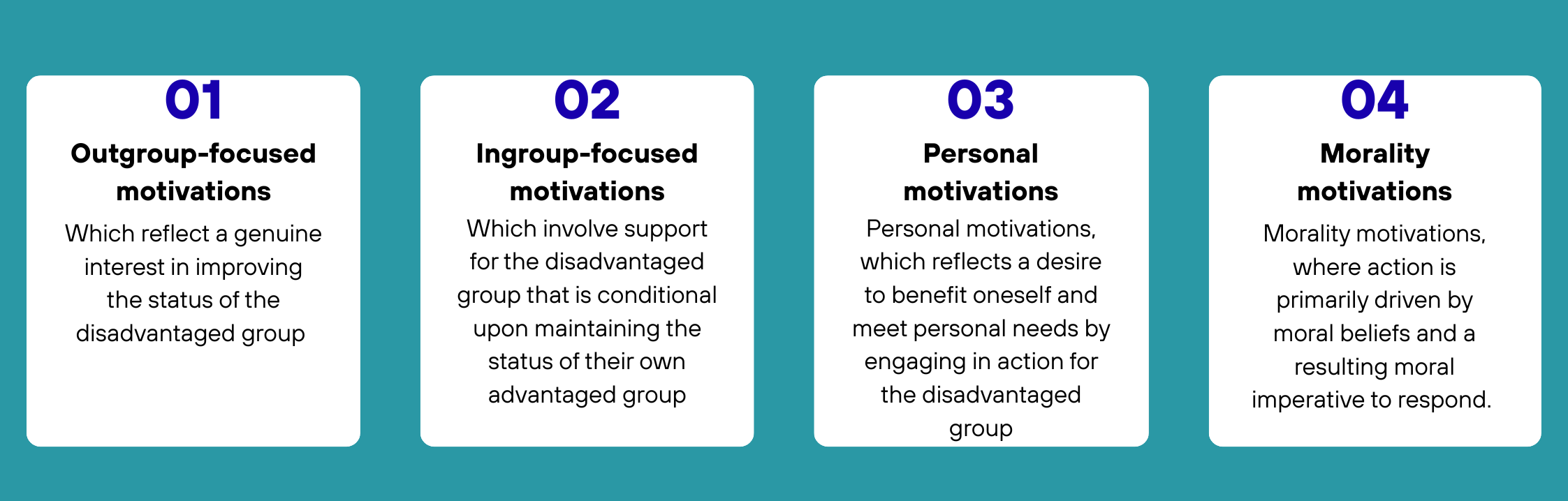
Four primary categories of motivation for allyship
According to Radke, there are four primary categories of motivations which drive allyship — and which are important to examine (109):